Compression Boots vs Ice Bath: Which Recovery Tool Is Actually Worth It?

Most people spend all their attention on the workout itself and almost none on what happens afterward — yet recovery is where the actual adaptation happens. Without it, the heavy legs, stiff joints and accumulated fatigue from a week of training just keep stacking up, and performance stalls even though the training itself is solid. Two of the most effective recovery tools you can add to a home setup are compression boots and an ice bath, and the two get compared constantly because they’re both marketed as “recovery essentials” — but they’re not interchangeable.
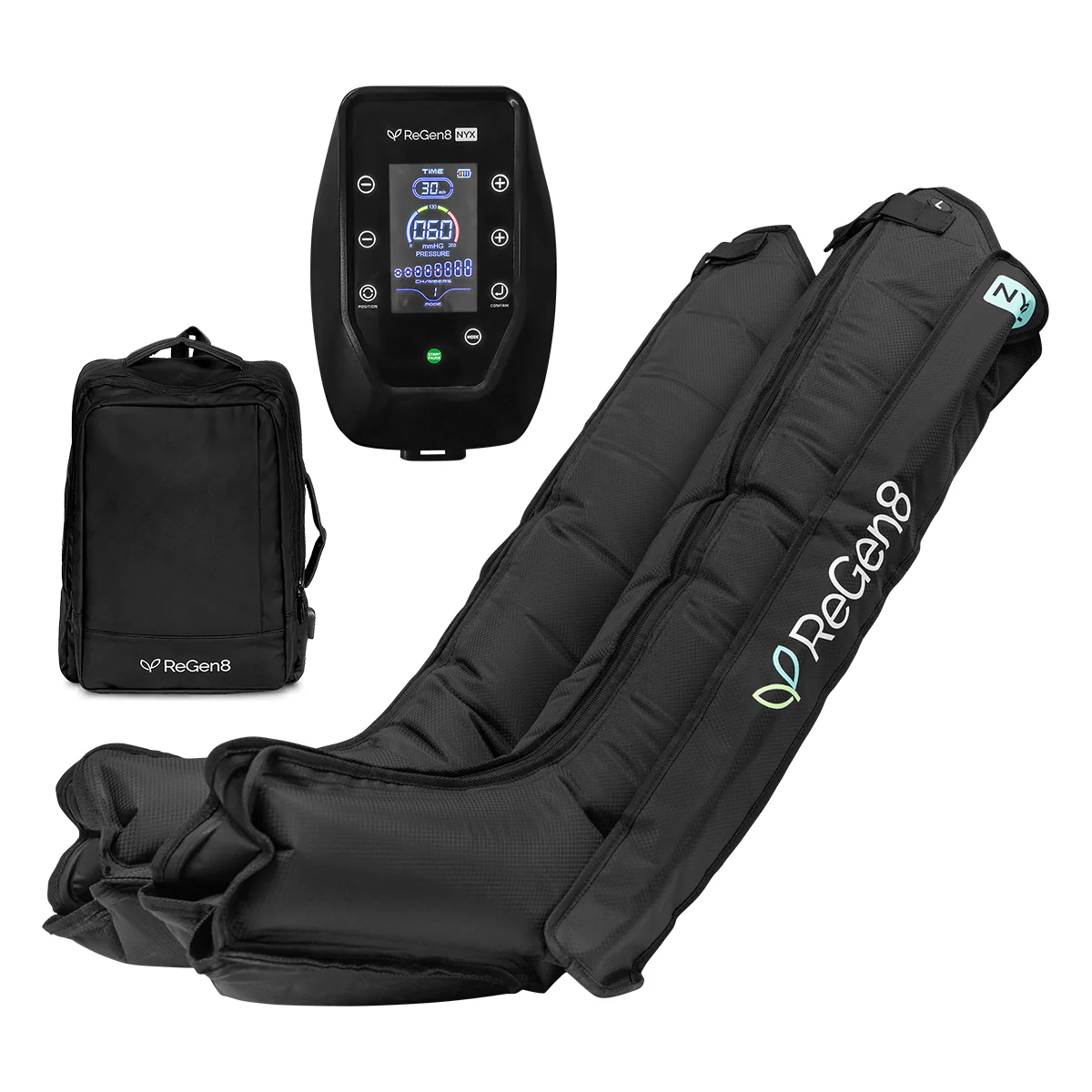
Quick answer: if you’re comparing compression boots vs ice bath for recovery, compression boots (like the Regen8 Nyx 8-Chamber Compression Recovery Boots, $699) are better for daily muscle soreness, circulation and leg fatigue after cardio or strength sessions, while an ice bath (the Regen8 470L PolarChill Cold Plunge, $749) is better for acute inflammation, joint recovery and mental resilience training. If you’re deciding between compression boots vs ice bath for your post-workout recovery, the short answer is: they solve different problems, and most serious athletes end up wanting both eventually.
On This Page
- Compression Boots vs Ice Bath: Quick Answer
- What Are Compression Boots?
- What Is an Ice Bath / Cold Plunge?
- Compression Boots vs Ice Bath: Side-by-Side
- Compression Boots vs Ice Bath: Which Should You Buy First?
- How to Use Each Safely
- Sample Weekly Recovery Routines
- FAQ
Compression Boots vs Ice Bath: Quick Answer
Both tools speed up recovery, but through completely different mechanisms. Compression boots use pneumatic pressure to push blood and lymphatic fluid back toward your core, reducing the heavy, swollen feeling in your legs after a long run, a heavy leg day, or a full day on your feet. An ice bath works by rapidly lowering tissue temperature, which constricts blood vessels, reduces inflammation at the site of muscle damage, and is widely used by athletes managing joint pain or training through a heavy competition block.
Neither is objectively “better” — they target different recovery needs. If your main issue is tired, heavy legs from cardio or hire equipment sessions (treadmill, spin bike, rower), start with compression boots. If you’re managing inflammation, joint pain, or training in hot conditions, the ice bath will do more for you.

What Are Compression Boots?
Compression boots are inflatable leg sleeves connected to a pump that inflates and deflates a series of air chambers in sequence, starting at the feet and working up toward the hips. This sequential squeeze mimics the muscle pump action your legs normally get from walking, pushing pooled blood and lymphatic fluid back toward your heart faster than passive rest alone.
The Regen8 Nyx 8-Chamber Compression Recovery Boots ($699) use 8 independent air chambers per leg for more precise, gradual pressure than cheaper 3-4 chamber units, with adjustable intensity levels so you can start gentle and build up. A typical session runs 20-30 minutes, and most people use them while watching TV, reading, or working — it’s a passive recovery tool, not something that demands your attention.
Compression boots are the better everyday tool if you’re regularly hiring or using treadmills, spin bikes, or rowers, or doing heavy leg-focused strength sessions — the leg fatigue and heaviness that builds up over a week of training is exactly what they’re designed to clear. Keep this in mind as we work through the rest of the compression boots vs ice bath comparison below.
What Is an Ice Bath / Cold Plunge?

An ice bath (or cold plunge) lowers your body temperature by full submersion in cold water, typically 10-15°C, for anywhere from 2 to 10 minutes. The rapid temperature drop constricts blood vessels near the skin and in working muscles, which limits swelling and inflammation immediately after intense training.
The Regen8 470L PolarChill Cold Plunge ($749) is a self-contained unit with its own chiller, so you don’t need to keep buying bags of ice — it holds a consistent target temperature and filters the water between uses. Beyond the physical recovery benefit, a lot of athletes also use cold plunges as a deliberate mental training tool: sitting through the discomfort builds the same tolerance you draw on in the last hard kilometre of a race or the last round of a fight.
An ice bath is the stronger pick if you’re managing a specific inflamed joint, recovering from a hard competition or event, or training in Brisbane’s summer heat where core temperature is already a factor. This lines up with the research: Mayo Clinic Health System notes that cold-water immersion in the 10-15°C range for around 10-15 minutes reduces delayed onset muscle soreness and speeds recovery, but frequent use right after strength training can blunt long-term muscle growth — which is exactly why we split ice bath and compression boot use by training type below.
Compression Boots vs Ice Bath: Side-by-Side
Here’s the full compression boots vs ice bath breakdown in one place, so you can compare both options at a glance before reading the detail below.
| Feature | Compression Boots (Regen8 Nyx) | Ice Bath (Regen8 PolarChill) |
|---|---|---|
| Price | $699 | $749 |
| Best for | Muscle heaviness, circulation, everyday leg fatigue | Inflammation, joint pain, mental resilience |
| Session length | 20-30 minutes | 2-10 minutes |
| Comfort level | Passive, low-effort, works while multitasking | Physically demanding, requires focus |
| Setup | Plug in, put boots on, done | Fill, chill to target temp, then submerge |
| Best paired with | High-volume cardio, treadmill/spin bike/rower sessions | Strength training, competition, hot-weather training |
Compression Boots vs Ice Bath: Which Should You Buy First?
If you can only start with one, let your actual complaint decide it:
- Choose compression boots first if your main issue is tired, heavy legs after cardio sessions, long days on your feet, or you want a low-effort recovery habit you’ll actually stick to.
- Choose the ice bath first if you’re managing a specific inflamed joint or tendon, training for a competition, or you want the mental toughness benefit as much as the physical one.
- Budget-conscious? Compression boots have the lower price point ($699 vs $749) and lower ongoing effort, making them the easier entry point for most home users.
Serious athletes training multiple times a week — particularly anyone doing structured treadmill training plans or heavy strength blocks — typically end up wanting both within a year, since they’re solving different problems rather than competing with each other.
How to Use Each Safely
Whichever side of the compression boots vs ice bath decision you land on, using either tool safely matters more than the tool itself.
Compression boots: Start on the lowest pressure setting for your first few sessions. Avoid use if you have a known blood clot risk, deep vein thrombosis, or an open wound on the leg — check with your doctor first if any of these apply. 20-30 minutes, 3-5 times a week, is a reasonable starting routine.
Ice bath: Start with shorter exposures (60-90 seconds) at a milder temperature and build up gradually — don’t jump straight to 10 minutes at the coldest setting. Avoid if you have cardiovascular conditions, Raynaud’s syndrome, or you’re pregnant, and never use a cold plunge alone if you’re new to it, in case of an unexpected reaction to the cold.
Sample Weekly Recovery Routines
Seeing how these tools actually fit into a real week of training makes the compression boots vs ice bath decision a lot more concrete than just comparing specs.
Endurance/cardio-focused week (running, treadmill training, spin bike, rowing): compression boots after your 3 hardest sessions of the week — typically your long run and your two interval days — for 25-30 minutes each. Add the ice bath once a week, ideally after your longest or most demanding session, for 5-8 minutes. The boots handle the day-to-day leg fatigue from volume; the ice bath is reserved for your single biggest recovery demand of the week.
Strength-focused week (heavy lifting, powerlifting-style training): ice bath after your 2 heaviest sessions (typically lower-body days), 3-5 minutes each, to manage joint and connective tissue inflammation before it compounds. Compression boots on your lighter or accessory days, 20 minutes, to keep circulation moving without adding cold-exposure stress on top of already-demanding sessions. Avoid using the ice bath immediately after your primary strength sessions if muscle growth is a priority — the research on cold exposure blunting hypertrophy adaptations is strongest when it’s used right after lifting, so shift it to a few hours later or the next morning instead.
If you’re still undecided on compression boots vs ice bath for a mixed training week, here’s a lower-risk starting point.
Mixed training (a bit of everything, general fitness): start with just the compression boots 2-3 times a week and see how your body responds before adding the ice bath — it’s the lower-commitment, lower-risk option to build a recovery habit around first, and you can layer in cold exposure later once that habit is established.
FAQ
Can I use compression boots and an ice bath in the same routine?
Yes — this is actually the most common resolution to the compression boots vs ice bath question. Many athletes use the ice bath immediately post-training to control inflammation, then use compression boots later the same day or the next morning to clear residual heaviness. They don’t need to be used back-to-back.
Compression boots vs ice bath: which is better for DOMS (delayed onset muscle soreness)?
Compression boots generally have the edge for DOMS, since the sequential pressure directly addresses the fluid buildup and circulation issues behind that heavy, stiff feeling 24-48 hours after a hard session.
For the compression boots vs ice bath setup, do I need a chiller for the ice bath, or can I just use ice?
The Regen8 470L PolarChill has its own built-in chiller, so you don’t need to buy or store ice at all — it maintains a consistent target temperature on its own, which is both more convenient and more consistent than manually topping up ice.
How often should I use compression boots?
3-5 sessions a week of 20-30 minutes is a reasonable starting point for most people training regularly. There’s no real risk of “overusing” them the way there can be with cold exposure, so daily use is fine if you find it helpful.
In the compression boots vs ice bath debate, is an ice bath safe every day?
Most people limit cold plunge use to 3-4 times a week rather than daily, since frequent cold exposure can blunt some of the muscle-building adaptations from strength training if used immediately after every single session. On rest days or after cardio-only sessions, daily use is generally fine.
Can beginners use these, or are they only for serious athletes?
The compression boots vs ice bath comparison isn’t just for advanced athletes — both are suitable for beginners. Compression boots in particular are low-risk and easy to start using immediately. For the ice bath, beginners should just start with shorter, milder sessions and build up gradually rather than diving straight into the coldest, longest setting.
What’s the difference between an ice bath and just a cold shower?
A cold shower rarely gets water cold enough or covers enough of your body at once to trigger the same vasoconstriction response as full submersion in a dedicated ice bath held at a controlled 10-15°C. A cold shower can take the edge off after a session, but it’s a much milder version of the same idea rather than a real substitute for a proper cold plunge.
Outside the compression boots vs ice bath sports-recovery context, do compression boots help with anything else?
Many people also use compression boots for general circulation support after long periods of standing or sitting, such as long flights or shift work on your feet all day. If you have a diagnosed circulatory condition, talk to your doctor first, but as a general recovery and comfort tool outside of sport, they’re widely used that way too.
Still weighing up compression boots vs ice bath? Want to see both in person before deciding? Visit us at Mr Treadmill — 126 Robinson Rd East, Geebung QLD 4034 — or call (07) 3865 4940 to check current stock.