
Power Rack vs Smith Machine: Which Is Right for Your Home Gym? (2026)


Working out the power rack vs Smith machine decision for your own home gym setup usually comes down to one core question: do you want to build raw strength with free-weight barbell lifts, or do you want the safety and simplicity of a guided bar path? Both are genuine home gym staples, but they solve different problems, and the price gap between them is real — a basic power rack starts around $269, while a full Smith machine combo can run past $3,700.
This guide compares six real units currently in stock at Mr Treadmill in Brisbane so you can see exactly what separates an entry-level rack from a commercial-grade Smith combo, and which one actually suits how you plan to train rather than just which one looks more impressive in a photo.
A power rack is better if your priority is free-weight barbell lifts (squat, bench, deadlift) with adjustable safety spotters — it’s cheaper, more versatile, and closer to how a commercial gym trains. A Smith machine is better if you train alone often and want the reassurance of a fixed, guided bar path, or if you want one machine that combines a rack, cable station and bench press in a smaller footprint. Prices at Mr Treadmill range from $269 for a basic power rack to $3,799 for a full Smith machine combo.
Power Rack vs Smith Machine: Full Comparison
| Unit | Type | Key Features | Price |
|---|---|---|---|
| Bodyworx Squat Rack | Power rack | 2x spotters, easy assembly | $269 |
| Bodyworx HD Squat Stand | Power rack | Free-standing, pull-up bar, J-hooks | $799 |
| Bodyworx Multi Press Rack | Power rack | 450kg-rated gun rack, plate storage | $699 |
| Bodyworx Basic Smith Combo | Smith machine | Smith + FID bench + lat pulldown + low row | $1,299 |
| Cortex SM-20 6-in-1 | Smith machine | Smith + cable system + multiple stations | $1,355 |
| York Fitness Weight Balanced | Smith machine | Counterbalanced bar, commercial build | $3,799 |
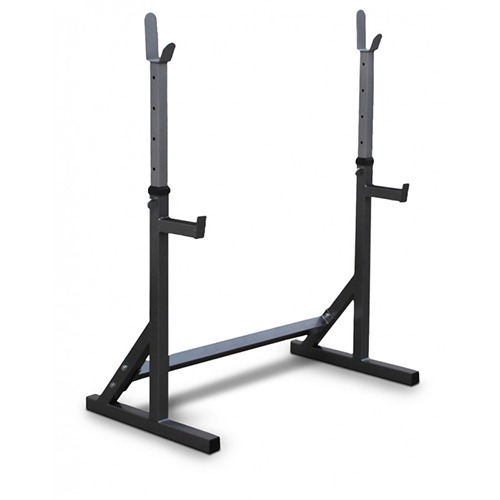
Bodyworx Squat Rack — the entry point into free-weight training at $269
What’s the Actual Difference?
A power rack is essentially a steel frame with adjustable J-hooks and safety bars — it holds a barbell at the height you set, and the safety bars catch the bar if you fail a lift. The bar itself moves completely freely; your body controls the entire path of the movement, which is exactly how a barbell moves in competitive lifting and most commercial gym training.
A Smith machine fixes the barbell to a set of vertical (or slightly angled) rails, so the bar only moves up and down along a single fixed path. This removes the need for a spotter on most lifts — the bar can be locked at any point with a simple twist — but it also means your stabiliser muscles do less work than a free-weight lift, since the machine is doing some of the balancing for you.
That trade-off isn’t necessarily a downside — it depends entirely on your training goal. If you’re chasing raw strength for a specific sport or competition, the reduced stabiliser demand on a Smith machine is a real limitation. If your goal is muscle growth, general fitness, or training safely and independently without a spotter, that same guided path is a genuine advantage rather than a compromise.
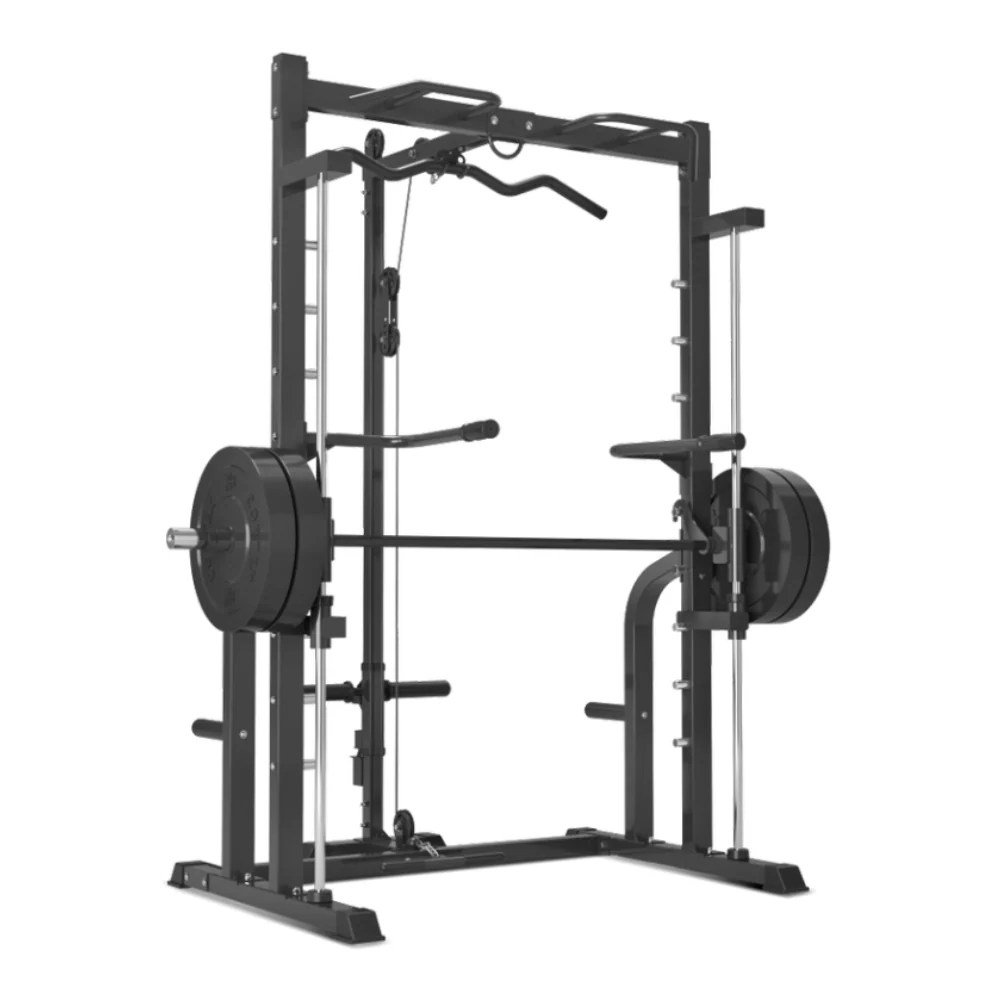
Cortex SM-10 Cable & Smith Machine — Smith machine, cable station, chin-up bar and dips in one unit
What Exercises Work Best on Each?
A power rack is built around the three big barbell lifts: back squat, bench press (using the rack’s spotter arms or J-hooks), and overhead press. It also works well for rack pulls, pin presses, and any exercise where you need to start the bar from a fixed height rather than the floor. Add a barbell and plates and a rack alone covers most of a serious strength programme.
A Smith machine covers those same three lifts but with the bar path fixed, plus it typically adds exercises a bare rack can’t do alone: standing calf raises using the locked bar as resistance, Smith machine lunges where balance is less of a factor, and (on combo units like the SM-20 or Basic Combo) cable exercises like lat pulldowns, seated rows, and tricep pushdowns that a power rack simply doesn’t offer without buying a separate cable machine.

Cortex SM-20 6-in-1 — Smith machine, cable system and multiple stations in one frame
Power Rack vs Smith Machine: Which One Should You Choose?
- Choose a power rack if you want to build real strength on the big compound lifts (squat, bench, deadlift, overhead press), you have a training partner or spotter available at least sometimes, and you’d rather spend less upfront on the rack itself and more on a bench and weight plates. A rack also makes more sense if you expect to add accessories over time — a lat pulldown attachment, dip bars, or a cable pulley system — since most power rack frames are designed to accept add-ons as your setup grows.
- Choose a Smith machine if you train alone most of the time and want the safety of a lockable bar, you want one machine that also covers cable exercises and a lat pulldown (like the Basic Combo or SM-20), or you’re newer to lifting and want a more guided introduction to barbell movement patterns before progressing to free weights.
- Consider both if budget allows — some combo units effectively give you a rack AND a Smith machine in one footprint, which is often the better use of floor space than buying two separate pieces of equipment. The Bodyworx Basic Smith Combo and Cortex SM-20 both fall into this category, bundling a rack-style frame, guided Smith bar, and cable functionality into a single unit rather than asking you to choose one feature set over the other.
Space and Budget Considerations
Power racks are generally the cheaper entry point — the Bodyworx Squat Rack at $269 gets you into free-weight training for less than a tenth of the price of the top Smith machine in this comparison. Smith machines cost more because you’re paying for the guided rail system and usually a cable stack or lat pulldown attachment bundled in, not just a bare frame.
Footprint-wise, a basic power rack is usually the smaller option — the HD Squat Stand is free-standing and doesn’t need to be bolted down, which matters if you’re renting. Smith machine combos with an integrated cable station take up more floor space but replace what would otherwise be 2-3 separate pieces of equipment (rack, cable machine, lat pulldown), so the space trade-off isn’t as one-sided as it looks at first glance.
Assembly time follows a similar pattern to price: a basic power rack like the Bodyworx Squat Rack is a straightforward weekend build for one person with a socket set, while a full Smith machine combo with a cable stack and multiple stations is a longer job, often better done with a second person to hold sections steady while you bolt the frame together. Neither requires a professional installer, but budget more time for the combo units than the simpler racks.
According to Healthdirect Australia, resistance training at least twice a week builds muscle and bone density and supports healthy long-term joint function — true regardless of which equipment you use to get there.
Not sure a rack or Smith machine is the right first step at all? See our guide on choosing fitness equipment for a family home gym, or browse our full dumbbell range if free weights alone are a better starting point for your space and budget.
Maintenance and Safety for Both Types
Both a power rack and a Smith machine are largely maintenance-free once assembled correctly — the main ongoing task is periodically checking bolts and connections haven’t worked loose with heavy use, and keeping the guide rails on a Smith machine free of dust so the bar moves smoothly. Neither requires the kind of regular servicing a cardio machine with a motor does.
Safety-wise, the biggest factor with a power rack is setting your safety spot bars at the correct height before every heavy set — it’s an easy step to skip when you’re in a rush, and it’s the entire reason a rack is safer to train alone with than a bare barbell. On a Smith machine, always confirm the bar is unlocked from its hooks before loading weight onto it, since a loaded bar left hooked in can put unexpected strain on the locking mechanism.
FAQ — Power Rack vs Smith Machine
Is a power rack or Smith machine better for beginners?
A Smith machine is often more approachable for a complete beginner since the fixed bar path removes some of the balance and coordination demands of free-weight lifting. A power rack has a steeper learning curve but builds more transferable strength and stability long-term.
Do I need a spotter with a power rack?
Not necessarily — the adjustable safety bars on a power rack are designed to catch a failed lift without a spotter present, which is one of the main reasons people buy a rack for solo home training.
Can a Smith machine build the same strength as free weights?
It builds real strength, but with less demand on stabiliser muscles since the bar path is fixed. Many lifters use a Smith machine alongside free weights rather than as a full replacement, for exercises like standing calf raises or controlled squats where the guided path is an advantage.
What’s the cheapest way into rack-based training?
The Bodyworx Squat Rack at $269 is the lowest-cost entry point in this range — a genuine power rack with adjustable spotters, without the cable station or bench bundled into a pricier combo unit.
Do Smith machine combos include a bench?
Some do — the Bodyworx Basic Smith Combo ($1,299) includes a fully independent FID utility bench with preacher pad and leg developer. Check the specific listing, since not every Smith machine on this list bundles a bench.
Can I see these in person before buying?
Yes — all six units are viewable at our Geebung showroom, 126 Robinson Road East. Call (07) 3865 4940 to check current stock before you visit.
How much floor space does a power rack or Smith machine need?
A basic power rack like the Bodyworx Squat Rack needs roughly a 1.2m x 1.2m footprint plus clearance to load the bar. Smith machine combos with a cable station need more — measure your space against the specific unit’s dimensions before ordering, especially for the larger combo units.
Can a power rack be used without a barbell and plates?
Technically yes for pull-ups or dips on models with those attachments, but a rack is built around barbell training — you’ll want a barbell and weight plates to get real value from it. Call us for a quote on a rack-and-weights package if you’re starting from scratch, and we can put together pricing for the rack plus a bar and plate set to match your budget and goals.


