
Treadmill vs Road Running: Which Is Better for You? (2026)

- Impact and Joint Stress
- Muscle Activation: Why Treadmill Running Feels Different
- Weather, Safety and Convenience
- Treadmill Running Form: What Changes Indoors
- Hills and Incline Training
- Does Treadmill Running Translate to Outdoor Race Performance?
- Calorie Burn: Is There a Real Difference?
- Which Is Better for Beginners and Injury Recovery?
- Combining Treadmill and Road Running
- FAQ
Impact and Joint Stress
This is the biggest practical difference in the treadmill vs road running comparison. Treadmill belts have a springy, cushioned deck designed to absorb impact, while asphalt and concrete give almost nothing back. That lower impact is exactly why so many runners move to a treadmill after a knee, shin or stress-fracture injury — and why physios often recommend it as a lower-risk way to maintain running fitness during recovery. Grass and well-maintained trail surfaces sit somewhere between a treadmill and hard pavement, which is worth knowing if your usual “outdoor” running isn’t all on concrete or asphalt.
The trade-off: running on hard outdoor surfaces, in moderation, also strengthens the tendons and bones that eventually need to tolerate real-world impact — so training exclusively on a treadmill forever isn’t necessarily ideal for someone building toward an outdoor race.
Muscle Activation: Why Treadmill Running Feels Different
A moving treadmill belt actively pulls the ground back underneath your foot, which means your legs don’t have to generate as much forward propulsion themselves. In practice, this shifts more of the work onto your quads and slightly reduces the hamstring and glute drive you get from pushing yourself forward on stationary ground outdoors. There’s also no air resistance to push against on a treadmill — a small but real difference at faster paces.
Neither pattern is “better” for fitness generally, but if you’re specifically training for an outdoor event, your outdoor running form and strength balance should take priority over treadmill time.
This is also why pace on a treadmill and pace outdoors don’t always feel equivalent at the same number. A runner who comfortably holds 10km/h outdoors might find the same speed on a flat treadmill feels slightly easier — which is where the common “add 1% incline” adjustment comes from (covered in the FAQ below).
Does Treadmill Running Translate to Outdoor Race Performance?
Mostly yes, with one caveat. Aerobic fitness, cardiovascular capacity and muscular endurance built on a treadmill transfer well to the road — your heart and lungs don’t know the difference. What doesn’t transfer automatically is pacing judgement on uneven terrain, running in a pack, and the specific stabiliser strength used to handle cambered roads, trail roots or loose gravel. Runners training almost entirely on a treadmill for an outdoor event generally benefit from adding at least one or two outdoor runs a week in the final month before race day, specifically to re-adapt to the surface and pacing feel.

Weather, Safety and Convenience
A treadmill removes every scheduling excuse: rain, humidity, Brisbane summer heat, early darkness in winter, or simply not wanting to run alone at night. For anyone training consistently through a Queensland summer, that alone can be the deciding factor — heat-related illness risk drops dramatically when you’re running indoors with a fan rather than outdoors at midday. A treadmill also removes traffic, uneven footpaths and off-leash dogs from the equation, which matters more than people expect for runners who’ve had a fall or near-miss outdoors.
Road running wins on variety and mental engagement — changing scenery, fresh air, and the option to run with a group or dog, none of which a treadmill can replicate. There’s also a genuine psychological factor: some runners find treadmill sessions mentally harder past 30-40 minutes precisely because the scenery never changes, even though the physical effort is identical.
Treadmill Running Form: What Changes Indoors
A few form habits are worth building specifically for treadmill running. Avoid looking down at your feet or the console for long stretches — it changes your posture and can affect your stride. Keep a light hand on the rails only when needed (for balance when adjusting speed), rather than holding on continuously, which shortens your natural stride and reduces the workout’s effectiveness. And resist the urge to overstride at higher speeds; the moving belt means a shorter, quicker stride is usually more efficient than reaching forward with each step, which is a common new-treadmill-runner mistake.
Hills and Incline Training
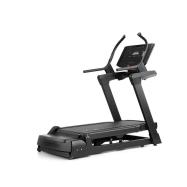
Unless you live somewhere genuinely hilly, replicating serious hill training outdoors on demand is hard. A treadmill with a strong incline range solves this instantly — our FreeMotion i10.9b Incline Trainer goes up to a 30% incline, well beyond what most outdoor routes offer, which makes it a genuinely better tool than the road for dedicated hill-strength and VO2 max work.
Calorie Burn: Is There a Real Difference?
At a matched pace and incline, calorie burn between treadmill and road running is close enough that the difference isn’t meaningful for most people. Where the numbers can drift apart is when a treadmill display overestimates burn (common on cheaper consoles) or when outdoor conditions — wind, heat, uneven trail terrain — push your effort higher than the same pace would feel indoors.
If you’re tracking calorie burn closely for weight management, a chest strap heart rate monitor paired with your treadmill’s console (or a fitness watch) will give a more accurate number than the console’s built-in estimate alone, regardless of which surface you’re running on.
Which Is Better for Beginners and Injury Recovery?
For beginners, a treadmill is usually the easier starting point: consistent pace control, a safety rail, and a forgiving surface while your running fitness and form develop. For anyone coming back from injury, it’s close to the default recommendation — see how Lauren used treadmill training to get back to competitive running after a serious injury, leaning on the lower impact to rebuild volume safely before returning to the road.
A treadmill also makes it much easier to follow a structured beginner program, since you can hit an exact pace and time without needing a watch, a measured route, or good lighting — useful if you’re following a specific couch-to-5km style plan rather than just running by feel.
Combining Treadmill and Road Running
Most experienced runners don’t actually pick one side of the treadmill vs road running debate — they use both deliberately. A common split: treadmill for structured interval or incline sessions where precise pace and gradient control matter, and the road for long steady-state runs where terrain variety and race-specific pacing practice matter more. Rotating between the two also spreads out repetitive strain, since the subtly different muscle demands of each surface give slightly different tissues a break week to week. A simple starting split for most recreational runners is two treadmill sessions and one or two outdoor runs per week, adjusted toward more outdoor volume as a specific race date gets closer.

Treadmill vs Road Running: Side-by-Side Comparison
| Factor | Treadmill | Road Running |
|---|---|---|
| Joint impact | Lower — cushioned belt | Higher — hard surface |
| Muscle activation | More quad-dominant | More hamstring/stabiliser work |
| Weather dependence | None | Fully exposed |
| Hill training | Precise, on-demand incline | Depends on local terrain |
| Best for | Beginners, injury recovery, structured training | Race prep, variety, free of charge |
| Ongoing cost | One-time equipment cost | Free (shoes aside) |
Not ready to commit to buying? You can try a treadmill at home first with treadmill hire from $16/week. For a full buying guide, see our Best Running Treadmill in Australia picks or our Best Treadmill for Home Use guide, and check what a treadmill actually costs to run if electricity use is a factor for you.
For a deeper breakdown of the biomechanics behind these differences, Healthline’s comparison of treadmill vs. outdoor running is a good independent source.
FAQ
Is treadmill running easier than road running?
It can feel easier at the same displayed pace, partly because the moving belt helps pull your foot back and there’s no air resistance. Many runners find a 1% incline on the treadmill roughly matches the effort of flat outdoor running.
Does treadmill running burn fewer calories than road running?
At a matched pace and incline, the difference is minor. Outdoor conditions like wind, heat or uneven terrain can push effort — and calorie burn — higher than an equivalent treadmill session.
Is a treadmill better for your knees than running on the road?
Generally yes — the cushioned belt absorbs more impact than asphalt or concrete, which is why treadmills are commonly recommended during injury recovery or for runners managing existing joint issues.
Can treadmill training prepare you for an outdoor race?
It can build strong aerobic and muscular fitness, but it won’t fully replicate outdoor terrain, pacing judgement, or weather conditions. Most runners combine treadmill sessions with regular outdoor runs in the weeks before a race.
Why does 1% incline on a treadmill matter?
Because a treadmill belt does some of the work of moving you forward and there’s no wind resistance, adding a small incline (commonly 1%) is a widely used way to make treadmill effort feel closer to flat outdoor running.
Is it safe to run on a treadmill every day?
For most healthy adults, yes, provided volume increases gradually and you vary pace/incline to avoid repetitive strain — the same principle that applies to running outdoors every day.
What incline should I use to simulate hills on a treadmill?
Start around 4-6% for a moderate hill feel and build up from there — incline trainers like the FreeMotion i10.9b that go up to 30% let you train well beyond what most outdoor routes can offer.
Should I hold the treadmill rails while running?
Only briefly, for balance when changing speed or incline. Holding on continuously shortens your stride and reduces how much work your core and stabiliser muscles are doing, which lowers the overall benefit of the session.
Why does treadmill running feel harder on the lungs but easier on the legs?
Without airflow from outdoor movement, a treadmill can feel warmer and more cardiovascularly demanding at the same pace, even though the belt is doing a small amount of the leg work for you — which is part of why many gyms position a fan directly in front of their treadmills.


